ARTICLE • 5 min
CSRD vs CSDDD: What's the Difference and How Do Both Affect Your Supplier Program?
July 7, 2026

If you follow EU sustainability regulations, you have certainly encountered both acronyms. The Corporate Sustainability Reporting Directive (CSRD) and the Corporate Sustainability Due Diligence Directive (CSDDD) are the twin pillars of the EU's approach to embedding sustainability accountability into corporate behaviour. Both were significantly amended by the Omnibus I package, formally adopted on 24 February 2026 and in force from 18 March 2026. Both have direct, practical implications for how you manage your supplier relationship, but they are not the same thing. Confusing them leads to compliance programs that miss what each one is actually asking for.
The clearest way to understand the difference is this: CSRD tells you to report on sustainability. CSDDD tells you to act on it.
The CSRD, underpinned by the European Sustainability Reporting Standards (ESRS), creates a mandatory disclosure regime. Companies in scope must report publicly on their environmental, social and governance impacts, risks, and opportunities in a standardized format, subject to independent assurance. It is fundamentally about transparency.
The CSDDD goes further. It creates a legal obligation to identify, prevent, mitigate, and account for actual and potential adverse human rights and environmental impacts across a company's operations and its value chain. It is not enough to disclose that risks may exist. Companies must demonstrate they have a process to find them and address them.
Omnibus I, the EU's simplification package, made substantial changes to both directives. Published in the Official Journal on 26 February 2026, the package narrowed the scope of both, extended timelines, and removed certain obligations.
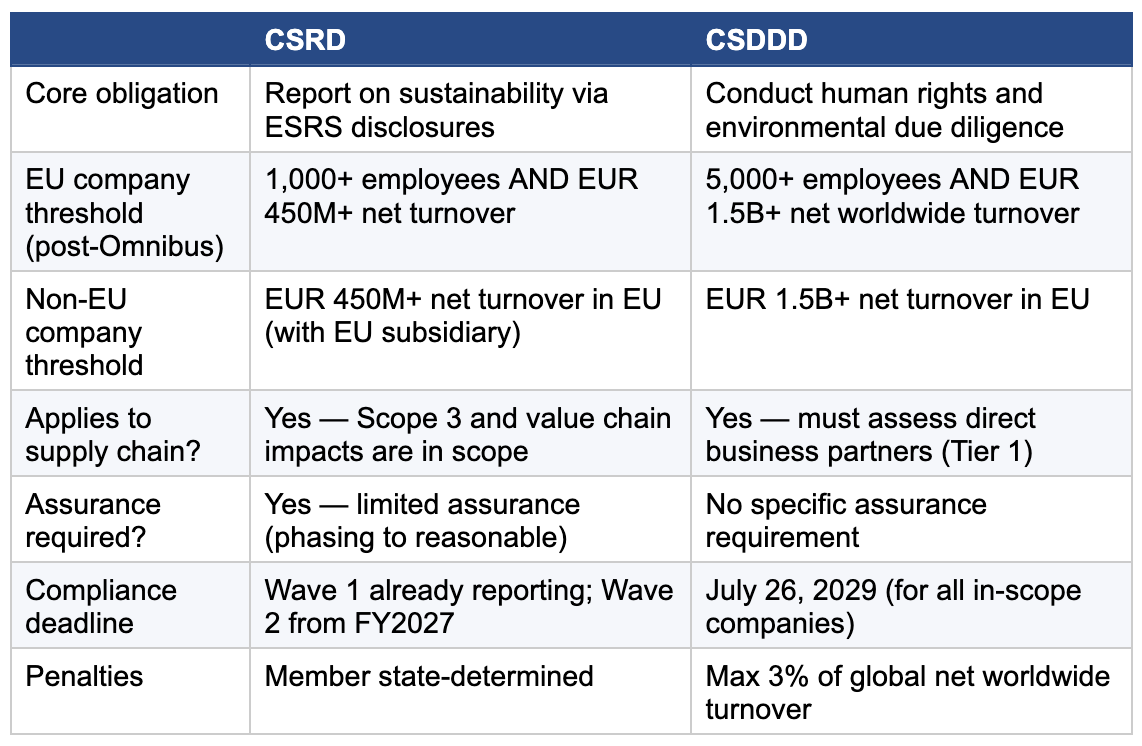
CSRD's supply chain implications flow primarily through the ESRS standards, particularly ESRS E1 (climate), ESRS S2 (workers in the value chain), and ESRS G1 (business conduct). Each requires data that, for most companies, does not sit within their own operations.
ESRS E1 requires disclosure of Scope 3 emissions, broken down by material category, with documentation of the methodology and the primary versus secondary data split. This means getting emissions data from suppliers, which requires a structured supplier engagement program rather than periodic questionnaires.
ESRS S2 covers the working conditions, human rights, and social risks facing workers throughout the value chain. This is where supplier ESG screening directly supports CSRD compliance: whether suppliers have health and safety policies, fair wage practices, and mechanisms for workers to raise concerns are all material disclosures under ESRS S2.
Practically, CSRD compliance for supply chain requires a supplier data collection program that produces auditable, structured output, not a collection of email attachments and PDF questionnaires.
The CSDDD requires a different kind of program. It is process-oriented rather than data-oriented. Companies must implement a due diligence policy, conduct risk identification across their chain of activities, take preventive and corrective action where adverse impacts are identified, and establish a mechanism for workers and affected communities to raise concerns.
Omnibus I narrowed the obligation to focus primarily on Tier 1 (direct business partners). For indirect business partners, companies need only engage where they have 'plausible information suggesting adverse impacts.' This is a significant reduction from the original directive, which required mapping across all tiers of the supply chain. Climate transition plans were also removed from the CSDDD, with that obligation remaining in the CSRD.
The CSDDD compliance deadline is a single date — from July 2029 — rather than the phased CSRD waves. For companies with 5,000+ employees and EUR 1.5B+ turnover globally, this is a firm deadline to have a functional supplier due diligence system in place.
For large companies subject to both directives, there is meaningful overlap. The CSDDD explicitly states that where a company is also subject to the CSRD, the CSRD's existing due diligence disclosure requirements satisfy most of the CSDDD's reporting obligations. The only additional CSDDD requirement is to describe how the due diligence process is carried out.
In practice, this means a well-designed supplier risk program serves both obligations simultaneously. A program that segments suppliers by risk, conducts structured assessments, tracks corrective actions, and produces documented evidence serves the CSRD's disclosure requirements and the CSDDD's operational requirements without being built twice.
If you are building or upgrading a supplier ESG program and want to ensure it addresses both frameworks, Socialsuite's Supplier Risk Assessment module is built with CSRD, CSDDD, and Modern Slavery Act compliance mapped across its core functionality. The CSRD compliance resources and compliance scanner modules provide a broader picture of where your obligations sit across both directives.
Omnibus I reduced the formal scope of both directives significantly, cutting CSRD coverage from approximately 50,000 companies to roughly 5,000 and narrowing CSDDD to the largest global enterprises. Some organisations have interpreted this as a signal to deprioritise preparation. That is a mistake. Customer and investor expectations for supply chain transparency have not narrowed alongside the regulatory scope. If anything, the companies now exempt from formal CSRD obligations are the ones whose large, in-scope customers are asking them for ESG data.
The direction of EU regulation is clear even through the simplifications: supply chain due diligence is moving from voluntary to mandatory, and the companies building capable programs now will be better positioned for every subsequent wave of regulation.

Whether it’s a public company, a private company, or a charity, Socialsuite has the right solution for you.