ARTICLE • 5 min
What to Look for in Supplier Risk Assessment Software: A Procurement Team's Buying Guide
July 6, 2026

The supplier risk assessment software market has expanded considerably over the past three years, driven by regulatory pressure, investor expectations, and a growing recognition that manual spreadsheet-based programs do not scale. The result is a range of platforms with significantly different underlying capabilities, all using similar language: automated screening, real-time monitoring, ESG intelligence, compliance-ready.
For procurement and sustainability teams evaluating their options, cutting through the marketing to understand what a platform actually does requires asking specific questions. This guide lays out the six capability areas that separate genuinely useful platforms from data portals dressed as software.
The most important differentiator between platforms is whether they can screen and profile suppliers automatically, without requiring suppliers to do anything first. Platforms that rely exclusively on supplier self-assessment to generate risk profiles are fundamentally limited by supplier response rates, which means their view of your supply chain is always incomplete.
What to look for: A platform that pulls from multiple external data sources, including ESG databases, country risk indices, adverse media feeds, sanctions lists, and certification records, to generate an initial risk profile before any supplier engagement begins. The profile should be comprehensive enough to prioritise your outreach intelligently, not just provide a single red/amber/green flag.
Questions to ask: How many external data sources does the platform aggregate? How frequently is that data updated? Can I generate a risk profile for a supplier that has never interacted with the platform?
The regulatory landscape for supply chain ESG due diligence varies by jurisdiction. A platform built for one context may not serve another. Australian and UK companies face Modern Slavery Act obligations. European companies and their global suppliers face CSRD and CSDDD requirements. Global multinationals often need to address all of the above simultaneously.
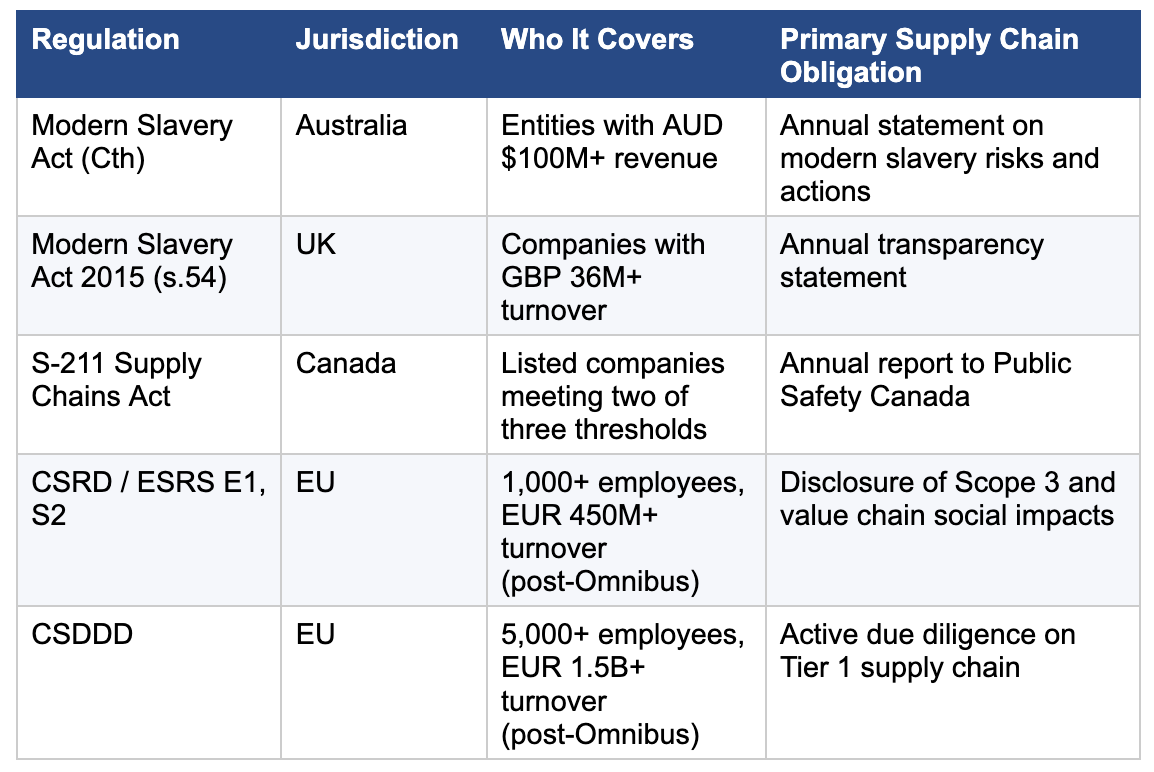
What to look for: Assessment frameworks and reporting templates that map to the specific regulations you face. Not every platform covers every jurisdiction, and some cover only the reporting side without addressing the due diligence operational requirements.
Supplier programs succeed or fail on engagement rates. A platform that creates significant friction for suppliers, by requiring them to pay to participate, register on a new system, or answer duplicate questionnaires they have already completed for other buyers, will produce lower-quality data at higher cost.
What to look for: A platform that minimises the burden on suppliers. Pre-populated profiles, simple questionnaire interfaces, and a clear explanation of why the request matters all improve completion rates. The absence of supplier fees is significant: platforms that charge suppliers to participate face consistent resistance, particularly from smaller suppliers with thin margins.
Questions to ask: Do suppliers pay to participate? Is the questionnaire pre-populated with existing information? What is the average completion time for a Tier 1 supplier survey?
An annual questionnaire cycle does not tell you about the labour violation that occurred in March or the environmental sanction that was issued in October. For high-risk supplier relationships, the period between formal assessments is exactly where material ESG events tend to go undetected.
What to look for: Continuous monitoring of high-risk suppliers using automated news feeds, regulatory update alerts, and sanctions list screening. The platform should surface material adverse events in near real-time and alert relevant program owners without requiring manual monitoring.
Platform pricing in this space can be opaque. Beyond the annual license, factors that affect total cost of ownership include: supplier fees (which effectively get passed back through pricing), implementation and integration costs, analyst time required to manage and interpret the platform, and the cost of manual processes the platform does not automate.
A platform that charges per supplier assessment, requires significant professional services to deploy, or demands substantial ongoing analyst input may have a lower headline price but a materially higher total cost than one that is more automated and self-serve.
Under CSRD, CSDDD, and modern slavery acts, the due diligence process itself is a disclosure. Assurance providers and regulators need to see not just the results of your supplier risk program but how those results were obtained, what methodology was used, and what actions were taken in response to findings.
What to look for: Timestamped assessment records, documented methodologies, corrective action tracking that links findings to remediation, and export functionality that produces the kind of evidence trail that will satisfy a limited assurance review. If the platform produces a dashboard but cannot generate the documentation needed to support an assurance engagement, it will not serve your compliance needs as regulatory requirements tighten.
When shortlisting platforms, structure your evaluation around the following questions:
Socialsuite's Supplier Risk Assessment module was built with criteria like these in mind. It sits within a broader sustainability platform that includes materiality assessment, climate risk scenario analysis, and compliance scanning, so supplier data does not sit in isolation from the rest of your sustainability program.

Whether it’s a public company, a private company, or a charity, Socialsuite has the right solution for you.