ARTICLE • 5 min
Industry Sustainability Benchmarks: How Does Your Sector Compare?
June 10, 2026

Sustainability performance benchmarking only makes sense within the context of your sector. A 15% reduction in carbon intensity means something very different for a cement manufacturer than for a software company. A living wage commitment is a baseline expectation in financial services but a leading practice in logistics.
Industry-specific benchmarks allow organizations to:
This post provides a sector-by-sector overview of sustainability benchmarking trends, drawing on the kinds of patterns that emerge when you analyze peer disclosures at scale.
When benchmarking within a sector, the most useful dimensions to analyze are:
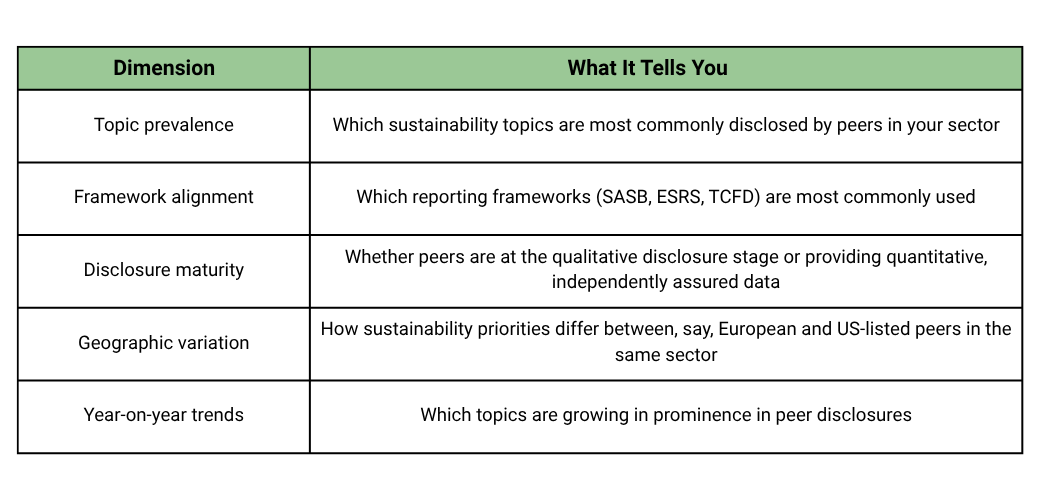
With that framing in mind, here is a snapshot of sustainability benchmarking trends across key sectors.
The technology sector has one of the highest rates of voluntary sustainability disclosure, particularly among listed US and European companies. Climate and energy metrics are near-universal, but supply chain labor standards and responsible AI governance remain inconsistent across the sector.
Organizations that benchmark well in this sector are increasingly moving beyond operational carbon (Scope 1 and 2) to comprehensive Scope 3 measurement, particularly hardware supply chains and product use-phase emissions.
Key gap opportunity: Many technology companies underweight social supply chain risks, particularly in hardware manufacturing and rare earth mineral sourcing.
Mining is one of the most heavily scrutinized sectors from a sustainability perspective. Disclosure depth varies significantly between large-cap producers and mid-tier operations. The sector's SASB standards are well-established and widely used, making framework-based benchmarking particularly meaningful.
Organizations with community relations and FPIC disclosures are increasingly differentiated from peers in investor assessments. Tailings governance, following high-profile disasters, is now a near-universal disclosure requirement for any listed miner.
Key gap opportunity: Biodiversity disclosure remains underdeveloped in many mining assessments despite its material relevance to operations.
Construction has historically lagged behind sectors like finance and technology in sustainability disclosure maturity. This is changing rapidly, driven by customer and investor pressure around embodied carbon and supply chain labor standards.
The most significant benchmark shift in recent years is the move from operational carbon (building performance) to embodied carbon (materials and construction processes). Organizations that are still reporting only on operational impacts are falling behind sector peers.
Key gap opportunity: Modern slavery risk in complex, multi-tier subcontracting chains is frequently underreported, creating both reputational and regulatory exposure.
The life sciences sector faces intense scrutiny on the intersection of commercial interests and public health. Benchmarking in this sector must account for both regulatory disclosures (e.g., CSRD) and voluntary frameworks as well as sector-specific indices such as the Access to Medicine Index.
Access and affordability disclosures are increasingly a differentiator in ESG ratings. Peer analysis shows that companies with structured access to medicines programs score significantly higher on social dimensions of sustainability assessments.
Key gap opportunity: Scope 3 from product use (particularly inhaler emissions in respiratory portfolios) is underreported relative to its material significance.
Transport and logistics is at the sharp end of the decarbonization challenge. Fleet emissions are almost universally disclosed among listed operators, but Scope 3 attribution (particularly helping customers understand the emissions intensity of their freight) remains a significant differentiator.
Driver welfare is an emerging topic in sector benchmarking. Organizations that can demonstrate fair pay, safe working conditions, and access to training for both employed and contract drivers are increasingly differentiated.
Key gap opportunity: Infrastructure-related nature and biodiversity impacts are largely absent from logistics sector disclosures, despite their regulatory relevance under frameworks like TNFD (Taskforce on Nature-related Financial Disclosures).
Professional services firms are often sustainability advisors to others, which creates a credibility imperative for their own disclosures. The most mature disclosures in this sector go beyond internal metrics to address how the firm's services contribute to clients' sustainability outcomes.
Diversity metrics are now near-universal but highly variable in depth: the benchmark is shifting from representation data to pay equity analysis and progression metrics by demographic group.
Key gap opportunity: Scope 3 from client work (the carbon intensity of projects delivered) is an emerging topic with very few peer comparisons to date, offering a genuine first-mover opportunity.
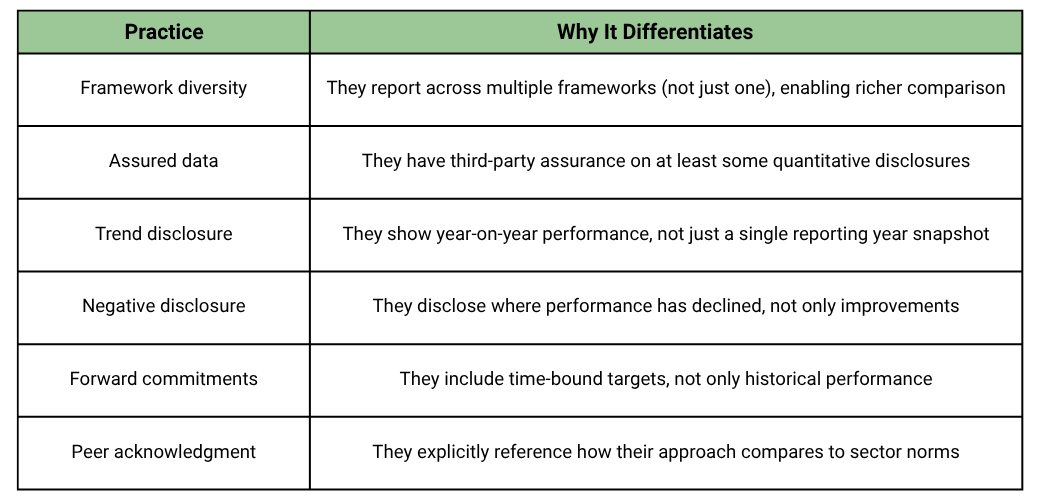
Across all sectors, the organizations that benchmark strongest share several characteristics:
“The companies doing the best sustainability work aren't just disclosing more. They're disclosing smarter, with clear context about where they stand relative to their sector and where they're heading. That context is what turns a report into a credible signal.” — Seth Forman, CEO, Socialsuite
Socialsuite's benchmarking platform covers 10+ industry sectors, allowing organizations to instantly see how their materiality assessment and sustainability disclosure stack up against sector peers.
The platform delivers:
Whether you are benchmarking for your first materiality assessment or refreshing an established program, sector-specific intelligence is the foundation of a credible, informed analysis.

Whether it’s a public company, a private company, or a charity, Socialsuite has the right solution for you.