ARTICLE • 5 min
Physical vs. Transition Climate Risk: Understanding the Difference
July 2, 2026

When climate risk comes up in a boardroom, the conversation often gravitates to flooding, wildfires, and extreme heat — the visible, dramatic face of a changing climate. These are real and material risks, but they only represent half of the climate risk landscape that sustainability leaders, CFOs, and boards are required to assess and disclose.
The other half, transition risk, is where many organisations have the larger financial exposure right now, and where disclosures are most frequently underdeveloped.
Understanding the distinction between physical and transition climate risk, and how both feed into the disclosure frameworks that are becoming mandatory in Australia, Europe, the US, and beyond, is foundational for anyone building a credible climate risk program.
Note that this article focuses on the risk side of the TCFD structure; the same framework also calls for disclosure of climate-related opportunities, which warrant their own dedicated treatment.
The TCFD framework — which underpins IFRS S2, ASRS S2, CSRD ESRS E1, and California SB261 — explicitly requires assessment of both physical and transition risks. Disclosure frameworks expect organisations to address both categories, explain their relative materiality, and describe the processes used to identify and manage them.
The challenge is that physical and transition risks operate very differently: they have different time horizons, different data requirements, and different implications for strategy and financial planning. A robust climate risk assessment treats them as distinct but complementary analytical workstreams.
Physical climate risks arise from the direct impacts of climate change on the physical environment. They fall into two sub-categories:
These are event-driven risks — episodic in nature, typically associated with extreme weather events that may increase in frequency or severity as global temperatures rise.
Examples include:
The financial impact of acute physical risks typically manifests as: asset damage and impairment, business interruption, increased insurance costs or loss of insurability, supply chain disruption, and emergency response expenditure.
These are longer-term shifts in climate conditions that alter the baseline operating environment, rather than discrete events.
Examples include:
Chronic risks often carry greater long-term financial materiality than acute risks, but are harder to quantify because they play out over longer time horizons and interact with other factors.
A rigorous physical risk assessment framework maps exposure across a comprehensive set of climate hazards. Physical risk methodologies vary by provider, typically assessing somewhere between ten and twenty distinct hazard categories, , including heat stress, cold stress, wildfire, flooding, cyclones, water stress, sea level rise, precipitation changes, and more. The goal is not just to flag risk, but to score it at the asset level across multiple warming scenarios and time horizons.
Transition risks arise from the process of shifting to a lower-carbon economy. They are not caused by physical climate change directly, but by the policy, technology, market, and societal responses to it. For many companies, particularly in carbon-intensive sectors or those with significant supply chain exposure, transition risks are financially material in the near to medium term.
Transition risks are typically categorised across four dimensions:
Regulatory change is the most direct transition risk. Examples include:
The introduction of mandatory climate disclosure itself — ASRS S2, IFRS S2, CSRD, SB261 — represents a policy and legal transition risk for companies that have not built the systems and processes to comply.
The rapid development of low-carbon technologies creates risk for companies with assets or business models tied to high-carbon alternatives. Examples include:
Shifts in supply and demand patterns driven by the energy transition affect pricing, revenue, and procurement costs. Examples include:
The social dimension of the transition creates risk for companies perceived as laggards or misaligned with climate objectives. This includes:
Unlike physical risk, where a fixed set of hazards can be scored against a company's known asset locations, transition risk doesn't lend itself to a standard checklist. The same policy shift, technology disruption, or market change can affect two companies in the same sector very differently depending on their specific business model, geographic footprint, value chain position, and capital structure. A carbon price has a different financial effect on a company that owns emissions-intensive assets outright versus one that outsources that exposure to suppliers; a shift to electric vehicles affects a parts manufacturer differently depending on which components it makes.
This means the quality of a transition risk assessment matters more than the quantity of risks identified. A long list of generic transition risk factors copied from a sector template is far less useful, and far less credible to auditors and investors, than a shorter list of risks that are clearly and specifically connected to how the company actually generates revenue, where its operations and suppliers sit in the value chain, and which markets and jurisdictions it depends on. The strongest disclosures trace each transition risk through to a concrete mechanism of financial impact, rather than asserting exposure in the abstract.
How Physical and Transition Risks Interact
Physical and transition risks are not independent. They interact in complex ways that can amplify or offset each other, depending on the climate scenario assessed.
In a low-warming scenario (1.5°C to 2°C), transition risks are high and physical risks are relatively contained. Aggressive climate policy, rapid technology change, and market shifts create significant near-term transition risk for many industries. Physical hazards are still a concern, but their worst-case trajectories are avoided.
In a high-warming scenario (3°C to 4°C and above), transition risks may be lower (because less aggressive policy has been pursued) but physical risks are substantially elevated. Asset damage, supply chain disruption, and chronic climate shifts become increasingly severe and costly.
This is why scenario analysis — the requirement embedded in TCFD, IFRS S2, and related frameworks — is so important. No single scenario captures the full risk picture. Organisations need to assess their exposure under multiple pathways to understand where the greatest financial vulnerabilities lie.
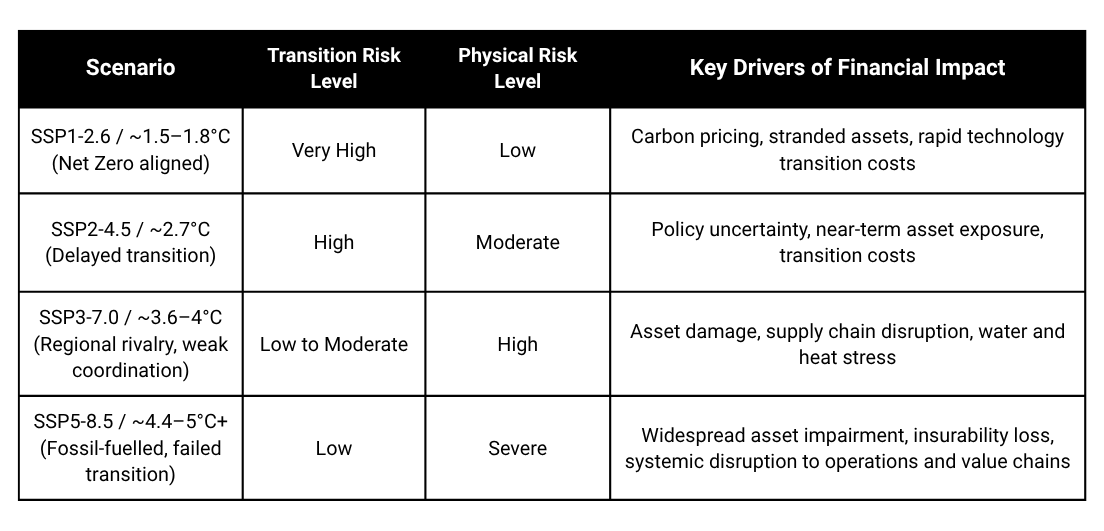
Note: Risk levels are illustrative and will vary by sector, geography, and asset class; they are not drawn from a single authoritative source.
Mandatory climate disclosure frameworks are unambiguous on this point: both categories of risk must be assessed and disclosed. Several common disclosure failures flow from focusing too heavily on one at the expense of the other.
Overweighting physical risk produces disclosures that look comprehensive — with flood maps, heat stress scores, and wildfire exposure quantified to the asset level — but that miss the strategic financial exposure the company faces from the energy transition. For companies in energy, manufacturing, financial services, or consumer goods, this can leave the most material risks undisclosed.
Underweighting physical risk is less common but occurs in sectors that feel distant from direct climate hazard exposure. This can leave organisations exposed to supply chain risks, infrastructure dependencies, and asset impairment that are not visible in a transition-only analysis.
The most credible disclosures reflect a genuine, balanced assessment of both dimensions, with transparency about which risks are assessed as most material and why.
For sustainability leaders building or improving their climate risk assessment process, several principles apply regardless of which disclosure framework they are reporting against:
Start with your operational footprint. Physical risk assessment requires knowing where your assets, operations, and key supply chain nodes are located. Without this, hazard data cannot be applied meaningfully.
Use recognised scenarios. Both physical and transition risk analysis should reference established climate scenarios (eg. IPCC AR6, IEA Net Zero by 2050, NGFS scenarios) rather than bespoke assumptions that will be difficult to justify to auditors and stakeholders.
Document your methodology. Disclosure frameworks require transparency about how risks were identified and assessed. The methodology — which hazards were assessed, which scenarios were used, how materiality was determined — must be documented and defensible.
Connect risk to financial impact. The direction of travel across all major frameworks is toward quantification. Physical risk scores need to translate into financial exposure: potential asset impairment, insurance cost changes, capital expenditure requirements. Transition risks need to connect to revenue exposure, cost increases, or stranded asset values.
Review regularly. Climate risk is not a static exposure. As the physical climate evolves, as policy frameworks develop, and as technology changes, the risk picture shifts. Annual or biennial review cycles are increasingly expected.
Physical and transition climate risks are different in character but equal in importance. The frameworks that govern climate disclosure — IFRS S2, ASRS S2, TCFD, CSRD, SB261 — require both. The organisations that will produce the most credible, durable disclosures are those that have built a systematic process for assessing both categories, connecting risk to financial impact, and integrating findings into strategy and governance.
Treating climate risk as synonymous with weather events is no longer sufficient — and disclosures that reflect that misunderstanding will become increasingly difficult to defend.
Socialsuite's climate risk platform covers both physical risk (mapped across 14 hazard categories at the asset level) and transition risk (spanning hundreds of risk factors across policy, technology, market, and reputational dimensions), under multiple IPCC and IAM scenarios. Purpose-built for ASRS S2, IFRS S2, TCFD, CSRD, and SB261 disclosure requirements. Learn more at socialsuitehq.com.

Whether it’s a public company, a private company, or a charity, Socialsuite has the right solution for you.