ARTICLE • 5 min
Sustainability Compliance Monitoring vs ESG Reporting Software: What's the Difference and Which Do You Need?
May 21, 2026

The sustainability software market has a labelling problem. Vendors use "compliance," "reporting," "monitoring," and "management" almost interchangeably, which makes it genuinely difficult for buyers to know what they're purchasing until they're already in a demo.
The distinction matters. ESG reporting software and ESG compliance monitoring software solve different problems at different points in the compliance cycle. Buying the wrong one doesn't just waste budget — it leaves gaps that create real risk.
Here's how to tell them apart.
ESG reporting software is primarily a production tool. It takes ESG data you've already collected and helps you produce structured disclosures aligned to reporting frameworks like GRI, ESRS, or ISSB. Core capabilities typically include framework templates that map your data to disclosure requirements, report generation tools that produce formatted outputs including XBRL-tagged files, collaboration features for managing review and sign-off, and data aggregation from multiple sources.
Reporting software is backward-looking. It takes a snapshot of your ESG performance over a defined period and produces a document that describes it. Done well, it makes the final mile of the reporting process significantly faster.
What it doesn't do is tell you whether you're compliant right now, flag new regulatory obligations as they emerge, or monitor whether your data collection is on track throughout the year. Think of it like a fire report: it documents what happened, clearly and accurately, after the fact.
ESG compliance monitoring is a continuous process, not a periodic output. A monitoring tool tracks your obligations, measures your current position against them, and flags gaps before they become audit findings or regulatory breaches. Core capabilities include real-time tracking of your compliance status against applicable frameworks, automated alerts when regulatory requirements change, gap identification across your dataset, continuous audit trail maintenance as data is collected, and supplier monitoring for Scope 3 obligations.
Monitoring is forward-looking and proactive. It's the smoke alarm — it tells you something needs attention before there's a fire.
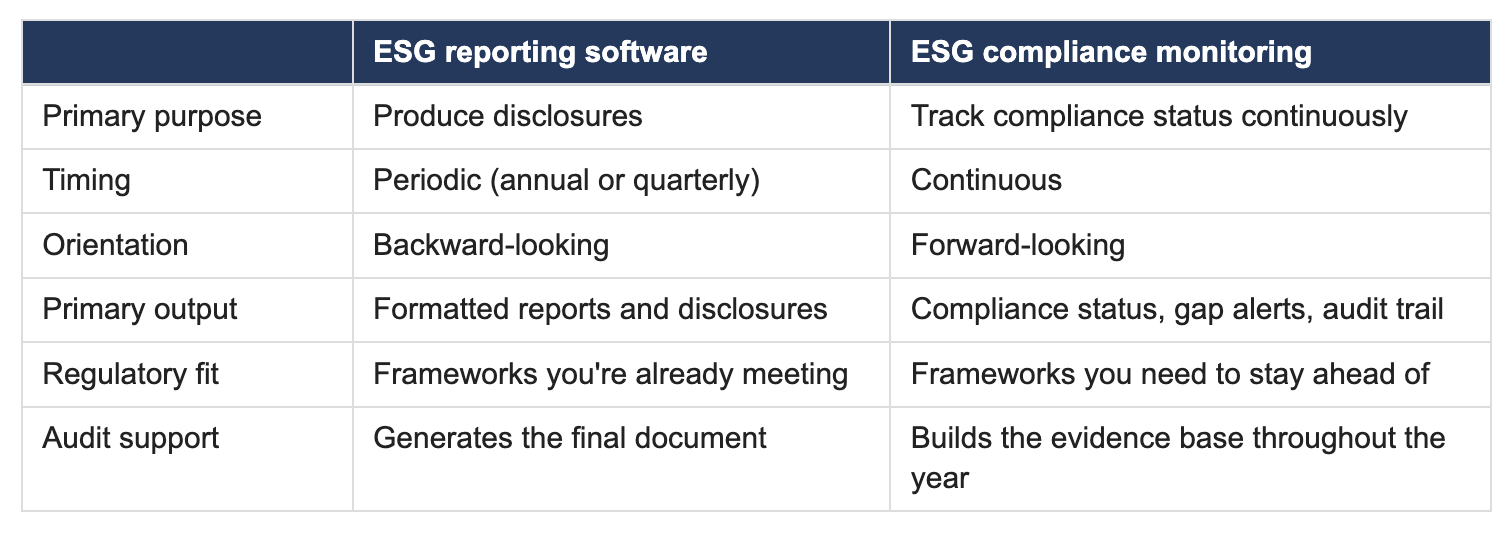
If your ESG data is already well-governed — collected consistently, owned clearly, methodologically documented — and your main challenge is producing the disclosure efficiently, a reporting tool does that job well. This is typically the position of mature ESG programs that have already invested in data infrastructure.
If any of the following describes your situation, you need monitoring more than you need reporting:
In short: if your biggest risk is not knowing you have a compliance gap until it's too late, that's a monitoring problem.
Most mature ESG programs use monitoring and reporting in sequence. Monitoring handles the continuous work — tracking obligations, collecting data with a built-in audit trail, flagging gaps, managing supplier requests. Reporting handles the output — taking that well-governed data and producing the disclosure.
Socialsuite Compliance Monitoring is built for the monitoring side of this equation. It tracks your regulatory obligations in real time, maintains an ongoing audit trail, and identifies compliance gaps as they emerge, so that when reporting time comes, the evidence base is already built. For most companies still building their ESG infrastructure, monitoring is the right starting point.
Whether you're evaluating a monitoring tool, a reporting tool, or something that claims to do both, these questions will quickly separate genuine capability from marketing language:
ESG reporting software and compliance monitoring software are not the same thing, and the difference matters. If your challenge is producing an efficient disclosure from data you already have, a reporting tool fits. If your challenge is knowing whether you're compliant right now — and staying that way through the year — you need monitoring.
See how Socialsuite Compliance Monitoring tracks your obligations and builds your audit trail continuously — book a 30-minute demo.

Whether it’s a public company, a private company, or a charity, Socialsuite has the right solution for you.