ARTICLE • 5 min
The Role of Competitive Intelligence in a Credible Double Materiality Assessment
June 11, 2026

The double materiality assessment (DMA) has moved from a conceptual framework to a compliance imperative. Under the Corporate Sustainability Reporting Directive (CSRD) and its associated European Sustainability Reporting Standards (ESRS), organizations subject to European regulation must conduct a DMA that assesses both:
A well-executed DMA is rigorous, evidenced, and defensible. Regulators, auditors, and stakeholders will scrutinize not only the outcomes of your DMA, but the process that produced them.
One element that is consistently underutilized in that process is competitive intelligence. Specifically: what are your peers disclosing, prioritizing, and identifying as material, and what does that tell you about your own assessment?
A DMA conducted without competitive intelligence is, by definition, missing a significant source of evidence. Here is why:
When a cluster of your sector peers identifies a particular topic as material, that is an implicit stakeholder signal. It reflects their collective assessment of what investors, customers, regulators, and civil society expect to see disclosed. Ignoring that signal is a methodological gap.
ESRS standards expect organizations to consider industry norms and stakeholder expectations as inputs to their materiality assessment. Peer benchmarking is a structured way to capture those expectations at scale.
Different organizations in your sector may use different frameworks. A competitor reporting under SASB may disclose sector-specific topics that you haven't mapped. Competitive intelligence reveals these framework-driven gaps before they become audit findings.
Under CSRD, sustainability reporting is subject to limited assurance (with reasonable assurance expected in future). Auditors will test the completeness and process robustness of your DMA. A DMA that includes documented peer benchmarking analysis is materially more defensible than one based solely on internal deliberation.
.png)
Financial materiality under ESRS requires identifying sustainability-related risks and opportunities that could affect your financial performance, cash flows, access to capital, or cost of capital over the short, medium, and long term.
Peer disclosures are a valuable input here. If competitors in your sector are beginning to disclose transition risks related to carbon pricing, or physical climate risks to their supply chains, that is market intelligence about where financial materiality is heading in your sector. Ignoring it creates a gap in your risk identification.
Impact materiality requires you to assess your actual and potential positive and negative impacts on people and the environment across your value chain. This is broader than most organizations have historically attempted.
Peer analysis reveals:
This intelligence directly informs the scope and depth of your own impact assessment, and reduces the risk that you've defined your boundaries too narrowly.
Here is how to systematically incorporate competitive intelligence at each stage of your DMA:
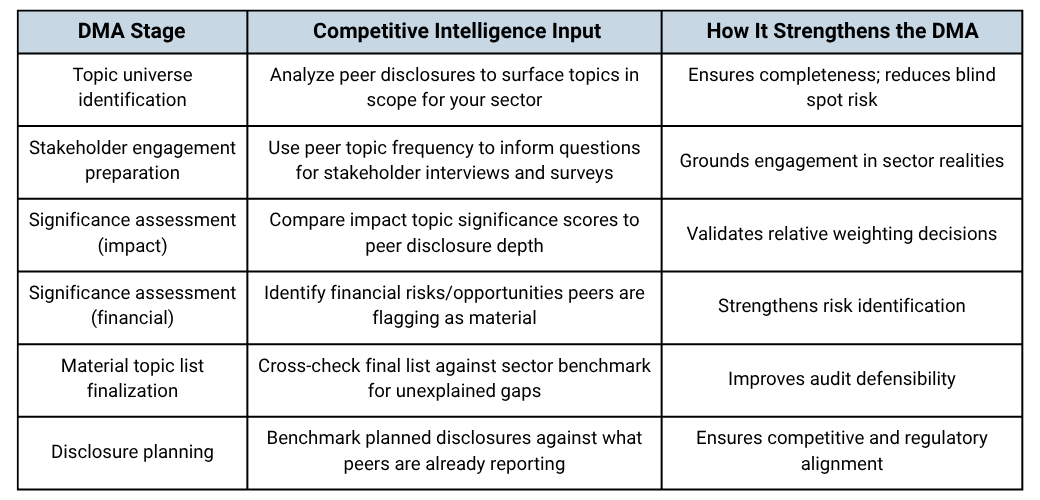
The simplified ESRS, the overarching standards for CSRD reporting, requires organizations to consider the perspectives of affected stakeholders and users of sustainability information as part of the DMA process. It also requires organizations to consider sustainability matters that are relevant to their sector.
These requirements create a strong implicit case for competitor benchmarking. Investors, regulators, and other users of sustainability information are increasingly sophisticated consumers of sector-wide data. They compare disclosures across companies. They notice omissions. They track topic prevalence.
An organization that can demonstrate it has systematically analyzed what its sector peers are disclosing and considered that intelligence in its DMA process is in a demonstrably stronger position under external scrutiny.
A DMA process that integrates competitive intelligence should be able to document:
This documentation is not only good practice. It is the foundation of a DMA that can withstand external assurance.
Socialsuite's platform is designed to support the full materiality assessment lifecycle, with competitive intelligence embedded throughout.
The benchmarking module delivers:
The output is a structured, evidenced body of competitive intelligence that can be directly referenced in your DMA documentation and presented to auditors, boards, and stakeholders as part of your materiality process.
When combined with Socialsuite's CSRD-aligned materiality assessment module, it provides an end-to-end platform for developing, benchmarking, and documenting a credible double materiality assessment.
Build a DMA that stands up to scrutiny. Start with the right intelligence. Book a Demo to See How Socialsuite Powers a Credible DMA.

Whether it’s a public company, a private company, or a charity, Socialsuite has the right solution for you.