Oops! Something went wrong while submitting the form.

“Simplified ESRS” is triggering a big question in the market: does this mean less double materiality?
Short answer: no. The real story is more important. The draft Simplified ESRS doesn’t weaken the double materiality assessment (DMA), it re-centres it. The shift is away from exhaustive, time-heavy scoring across everything, and toward clearer, faster, more defensible judgement that can stand up to assurance.
That’s exactly what we’ll unpack in this 30-minute session: Learn how Simplified ESRS shifts double materiality from exhaustive scoring to defensible judgement.
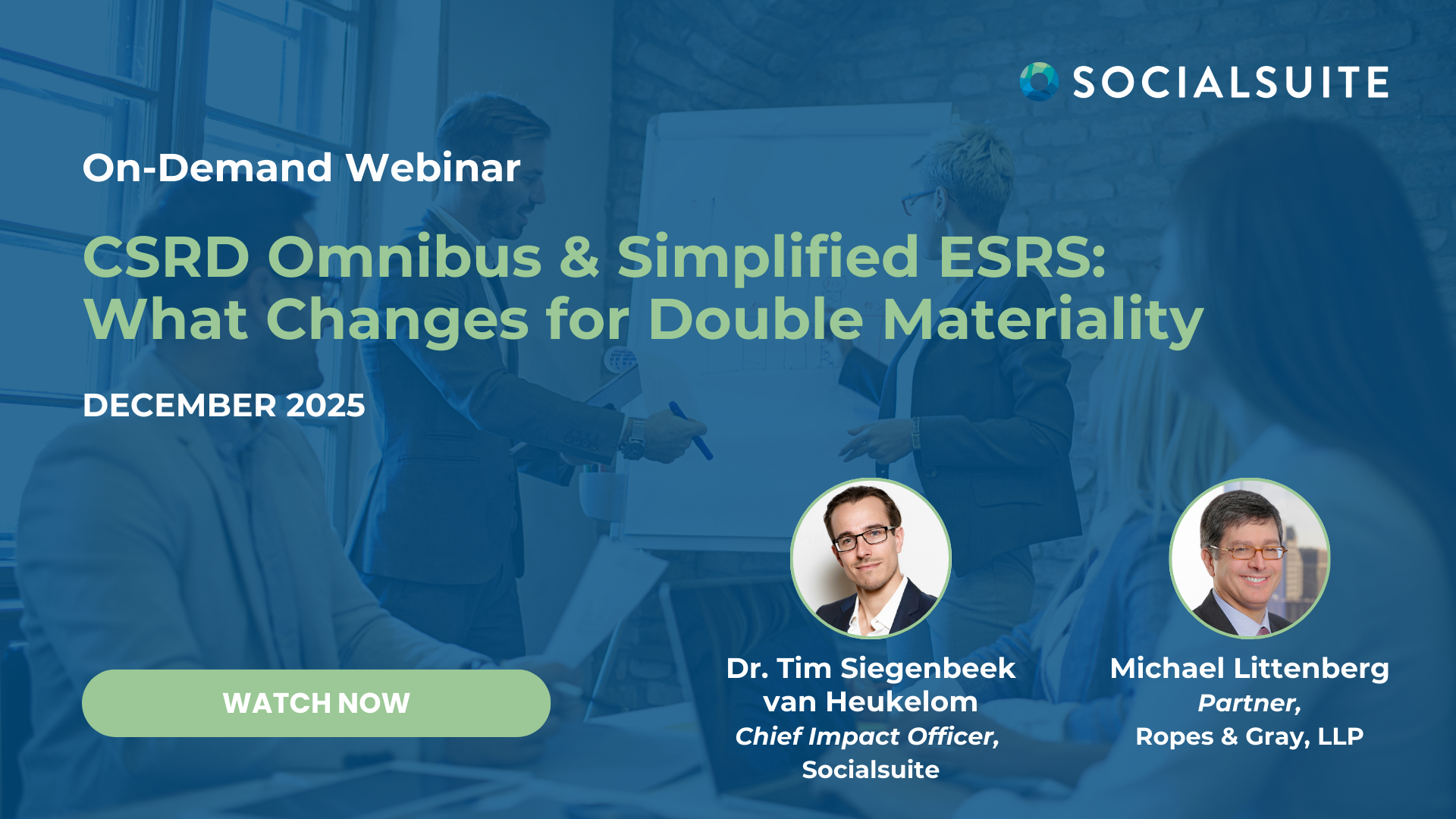
Join Tim (Chief Impact Officer at Socialsuite) and Michael Littenberg (Partner at Ropes & Gray) for a practical conversation on what’s changed and what that means for your next DMA cycle.
We’ll cover:
If you’re running, advising on, or preparing for an ESRS-aligned DMA, you’ll leave with a sharper way to simplify without increasing risk; and a clear sense of what to prioritise in 2026 planning.

Tim is Chief Impact Officer at Socialsuite, where he spearheads the development of ESG technology that helps organisations identify, prioritise, and report on their most material sustainability issues. With more than a decade of global sustainability experience and deep ESG expertise in strategy, programs, and reporting, Tim has worked across public, private, and non-profit sectors.

Michael is the global head of Ropes & Gray’s ESG, CSR & Business and Human Rights compliance practice. He is widely recognized as a leading ESG, CSR and business and human rights practitioner, having advised clients on compliance requirements and stakeholder expectations for his entire career. He has authored hundreds of thought leadership pieces on a diverse range of ESG, CSR and Business and Human Rights topics, and is often quoted in the media.
“Simplified ESRS” is triggering a big question in the market: does this mean less double materiality?
Short answer: no. The real story is more important. The draft Simplified ESRS doesn’t weaken the double materiality assessment (DMA), it re-centres it. The shift is away from exhaustive, time-heavy scoring across everything, and toward clearer, faster, more defensible judgement that can stand up to assurance.
That’s exactly what we’ll unpack in this 30-minute session: Learn how Simplified ESRS shifts double materiality from exhaustive scoring to defensible judgement.
Join Tim (Chief Impact Officer at Socialsuite) and Michael Littenberg (Partner at Ropes & Gray) for a practical conversation on what’s changed and what that means for your next DMA cycle.
We’ll cover:
If you’re running, advising on, or preparing for an ESRS-aligned DMA, you’ll leave with a sharper way to simplify without increasing risk; and a clear sense of what to prioritise in 2026 planning.
Tim is Chief Impact Officer at Socialsuite, where he spearheads the development of ESG technology that helps organisations identify, prioritise, and report on their most material sustainability issues. With more than a decade of global sustainability experience and deep ESG expertise in strategy, programs, and reporting, Tim has worked across public, private, and non-profit sectors.
Michael is the global head of Ropes & Gray’s ESG, CSR & Business and Human Rights compliance practice. He is widely recognized as a leading ESG, CSR and business and human rights practitioner, having advised clients on compliance requirements and stakeholder expectations for his entire career. He has authored hundreds of thought leadership pieces on a diverse range of ESG, CSR and Business and Human Rights topics, and is often quoted in the media.